
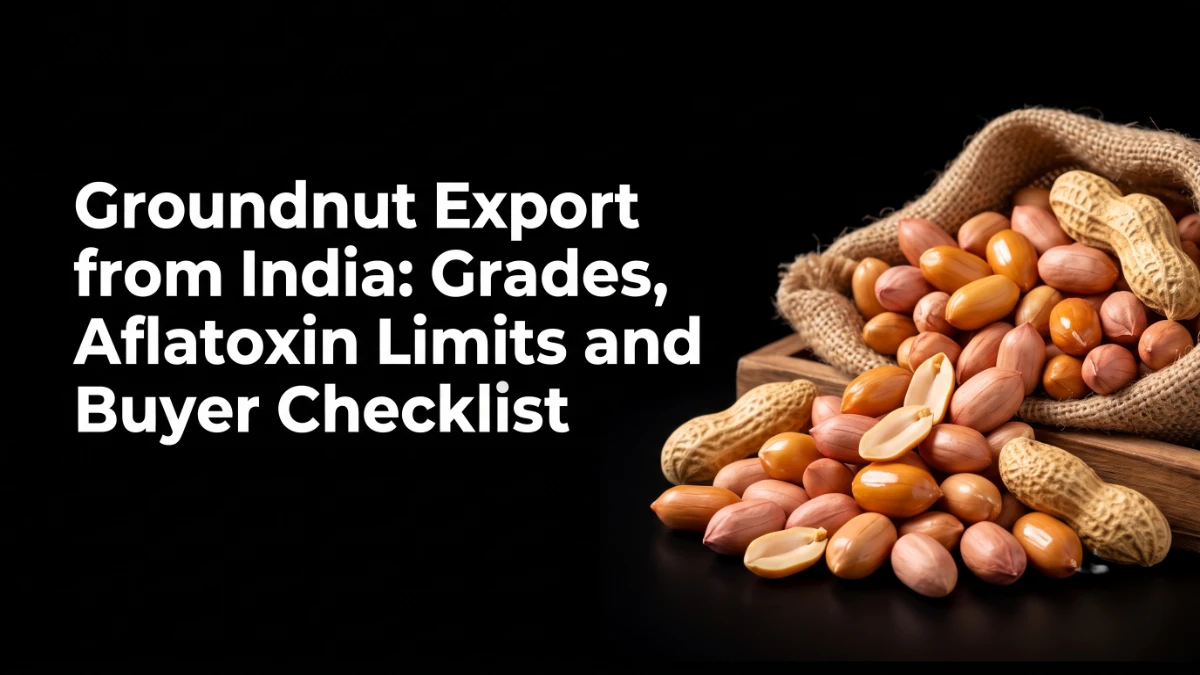
Groundnut Export from India: What Global Buyers Need to Verify
Groundnut export from India reached 663,809.68 MT worth USD 690.93 million in FY 2025–26, according to DGCIS figures published by APEDA. Behind that headline sits a commodity where two shipments carrying the same nominal grade can perform very differently on arrival — because acceptance is decided by aflatoxin result, moisture, count size and sorting history, not by the trade name on the invoice.
This guide sets out the specifications, grades, regulatory limits and packing conventions that professional importers check before releasing a purchase order.
What Is Groundnut (Peanut)?
Groundnut (Arachis hypogaea) belongs to the legume family Fabaceae. Its pods ripen underground rather than on the plant, which is why it is traded simultaneously as an oilseed and as an edible nut.
India is the world’s second-largest producer of groundnuts. Indian material is offered in three broad commercial types — Bold (also called Runner), Java (also called Spanish) and Red Natal — sitting above a long list of named cultivars including Kadiri-2, Kadiri-3, BG-1, Kuber, GAUG-1, GAUG-10, T-28, T-64, Chandra, Chitra and Amber.
Buyers select by end use rather than by cultivar. Bold kernels, larger and rounder, dominate confectionery, snack roasting and European demand. Java kernels, smaller and more uniform, are widely traded into Southeast Asian food manufacturing and crushing.
How Indian Groundnuts Are Grown and Processed
Groundnut is largely a rain-fed crop in India, grown across Gujarat, Rajasthan, Madhya Pradesh, Tamil Nadu, Uttar Pradesh, Andhra Pradesh, Maharashtra, Karnataka, West Bengal and Telangana. Roughly three-quarters of the crop comes from the kharif season (June to September), with the balance from rabi (November to March), giving two harvest windows in March and October.
Post-harvest handling is where export quality is won or lost. Pods are field-dried and then dried further to a target moisture, shelled, and passed through gravity separation and colour sorting to strip out damaged, discoloured and shrivelled kernels — the fraction that carries most of the aflatoxin load. Kernels may then be blanched (skin removed), split, or vacuum-packed depending on the contract.
Key Properties and Specifications
The table below reproduces the specification published on Ankitraj Expotrade Agro’s groundnut page. Treat it as an indicative baseline: contract specifications for export lots are normally tightened to the destination market’s limits.
| Parameter | Published Value |
|---|---|
| Moisture | 8% max. |
| Admixture | 1% max. |
| Foreign material | 1.00% max. |
| Oil content | 42% – 48% |
| Aflatoxin | 5 ppb (TLC method) |
| Botanical name | Arachis hypogaea |
Count size, variety, and broken/split percentages are agreed separately at order stage and should always appear on the sales contract.
Uses in the Food Industry
Food manufacturing absorbs the largest share of internationally traded groundnut kernels, and each application places different demands on the specification.
- Snack roasting: oil-roasted and dry-roasted salted kernels require uniform count size so that colour develops evenly across the batch. Bold grades in the 38/42 and 40/50 count ranges are typical.
- Peanut butter: blanched kernels with skins removed, low broken content and tight aflatoxin control. Because grinding concentrates any contamination through the whole batch, buyers here screen hardest on mycotoxin results.
- Confectionery and bakery: coated peanuts, brittles, chikki, nut bars and inclusions. Appearance matters as much as flavour, so discoloured and shrivelled kernels are heavily penalised.
- Peanut flour: defatted material used as a protein ingredient in bakery, nutrition and meat-analogue formulations.
- Culinary and retail packs: raw shelled kernels and in-shell nuts sold for direct household consumption.
The regulatory divide matters commercially. Lots destined for direct human consumption face materially stricter aflatoxin limits than lots that will be sorted or otherwise physically treated before consumption, so declaring the intended end use accurately at contract stage is not a formality — it determines which limit the consignment is judged against at the border.
Uses in Oil Milling and Animal Feed
Groundnut is India’s principal oilseed, and crushing remains the domestic backbone of the crop. At an oil content in the 42–48% range, kernels yield groundnut oil used for cooking, frying and food processing, valued for its high smoke point and neutral profile.
Crushing leaves groundnut cake or de-oiled meal, a high-protein residue that moves into cattle, poultry and aquaculture feed formulations. For feed buyers the arithmetic is different from food buyers: protein content and consistency drive value, but aflatoxin still governs acceptance, since mycotoxins carry through into milk and animal tissue.
Seed-quality groundnut forms a third trade stream, classified separately at customs and bought on germination performance.
Other Industrial Applications
Beyond food and feed, groundnut supports several secondary industries. Shells are used as biomass fuel, as particle-board and composite filler, and as an abrasive medium. Refined groundnut oil feeds into oleochemical processing and into cosmetic and personal-care formulations, where it appears as a carrier and emollient oil.
Protein isolates from defatted meal are also finding use in plant-protein product development, though these are specialised streams with their own technical specifications rather than routine commodity trade.
Grades and Quality Parameters Buyers Should Check
A groundnut contract that lists only “moisture and aflatoxin” is under-specified. A complete purchase specification covers:
- Variety and type — Bold/Runner, Java/Spanish, TJ or Red Natal, stated explicitly.
- Count per ounce (CPO) — the primary sizing convention; common ranges include 35/40, 38/42, 40/50, 45/55, 50/60, 60/70 and 70/80.
- Moisture — usually 7–8% maximum; higher moisture invites mould growth in transit.
- Aflatoxin — state whether the limit refers to B1 alone or total B1+B2+G1+G2, and name the analytical method.
- Broken, split and damaged kernels — separate percentage caps for each.
- Admixture and foreign matter — typically 1% maximum.
- Oil content — critical for crushing contracts, secondary for snack contracts.
On method, insist on precision. Thin-layer chromatography is a screening technique; European and Japanese buyers generally expect HPLC or LC-MS/MS results from an accredited laboratory, together with a sampling plan appropriate to the lot size.
Packaging, Storage and Shelf Life
Ankitraj Expotrade Agro packs groundnuts in new jute bags of 10, 15, 25 and 50 kg gross, and in vacuum packs with an outer layer of PP woven bags at 25 kg gross. A 20-foot FCL loads approximately 19 MT, equivalent to 380 bags at 50 kg.
Storage discipline protects the aflatoxin result you paid to certify. Kernels should be held in a cool, dry, well-ventilated warehouse, off the floor and clear of strong-odour materials. Vacuum packing slows oxidative rancidity in high-oil kernels and is standard for long ocean transits. Confirm declared shelf life against the supplier’s own storage data rather than an assumed industry figure.
Why Source Groundnuts from India
Three factors underpin groundnut export from India. First, scale: production was estimated at 130.74 lakh tonnes for 2025–26, spread across ten major states, which cushions buyers against a single region’s crop failure. Second, continuity: the two-crop kharif and rabi cycle delivers harvests in both March and October, supporting year-round availability rather than a single annual window.
Third, regulatory infrastructure. Export of peanut and peanut products is subject to APEDA registration and to aflatoxin certification issued by approved laboratories, and APEDA operates a dedicated traceability system for the commodity. India’s principal established destinations in FY 2025–26 were Indonesia, Vietnam, Malaysia, China and the Philippines, so trade lanes into Asian food manufacturing are well developed. Full details are published by APEDA.
How to Choose a Reliable Groundnut Exporter
Screen suppliers on evidence rather than claims:
- Verify APEDA registration and the aflatoxin certification route for peanut and peanut product exports.
- Ask for a batch-specific certificate of analysis covering moisture, aflatoxin, admixture, count and damage — not a generic datasheet.
- Confirm the testing laboratory’s accreditation and the analytical method used.
- Check quality-system certifications such as ISO 9001 and ISO 22000, and Star Export House recognition.
- Confirm the sampling plan for your lot size, particularly for EU-bound consignments.
- Establish who bears the cost if a shipment fails aflatoxin testing at destination — before signing.
Ankitraj Expotrade Pvt Ltd has operated since 1982 as a Star Export House with ISO 9001 and ISO 22000:2018 certification, serving over 70 countries. Full product details are available on the groundnut (peanut) product page.
Frequently Asked Questions
What is the difference between groundnut and peanut?
None — they are the same commodity, Arachis hypogaea. “Groundnut” is standard in Indian, African and British trade usage; “peanut” is standard in North American usage. Contracts, customs classifications and laboratory reports may use either term interchangeably.
What aflatoxin limit applies to Indian groundnuts?
It depends entirely on the destination and the declared end use. Codex sets a maximum level of 15 µg/kg for peanuts intended for further processing. The European Union applies markedly stricter limits for groundnuts intended for direct human consumption, with higher levels permitted for lots that will be sorted or physically treated first. Always contract to the buyer’s national limit.
What HS code applies to groundnut export from India?
Heading 1202 covers groundnuts not roasted or otherwise cooked. In-shell material falls under 1202 41, shelled kernels under 1202 42, and seed-quality groundnut under 1202 30, with further national sub-headings. Confirm the exact eight-digit code with your customs broker.
What is CPO in groundnut grading?
CPO means counts per ounce — the number of kernels in one ounce, which is how kernel size is specified in the peanut trade. A lower count number means larger kernels. It is a required field in any serious purchase specification.
Which countries import the most groundnuts from India?
In FY 2025–26, DGCIS recorded Indonesia, Vietnam, Malaysia, China and the Philippines as India’s leading groundnut destinations, reflecting strong demand from Southeast Asian snack and food-manufacturing sectors.
Conclusion
Groundnut export from India offers scale, two annual harvest windows and an established regulatory framework — but the commercial outcome rests on specification discipline: named variety, stated count, defined aflatoxin basis and an accredited test method. Get those four right and border rejections largely stop being a risk.
For grade availability, current specifications and pricing, contact the Ankitraj Expotrade Agro team with your destination market and intended end use.